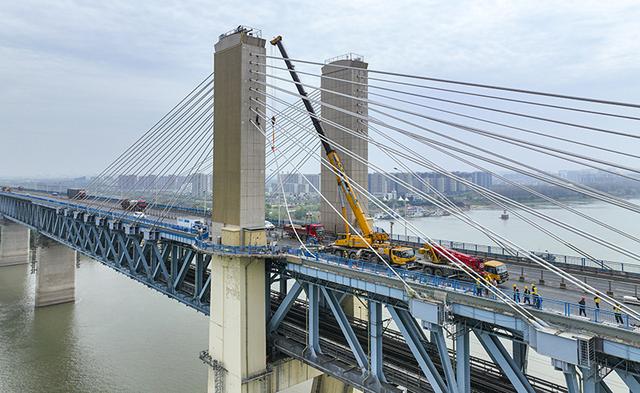
When you picture a modern, elegant bridge stretching across a wide river or bay, you’re likely imagining a cable-stayed bridge. These iconic structures, with their towers reaching for the sky and cables fanning down to support the deck, are a testament to the power of prestressed concrete and advanced steel technology. At the heart of their strength and longevity are the stay cables—the slender but mighty components that do the heavy lifting.
In this comprehensive guide, we’ll explore the critical role of stay cables in bridge construction, demystify the prestressing principles that make them so effective, and delve into the design, installation, and monitoring processes that ensure their safety. We’ll also look at why this system has become a go-to choice for engineers worldwide and what the future holds for this dynamic field.
What Are Stay Cables? The Lifelines of a Bridge
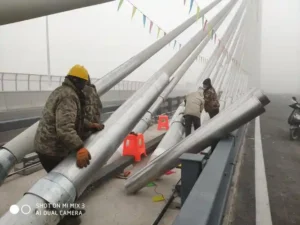
Stay cables are high-strength, steel tensile elements that transfer the load of the bridge deck to the tower or pylon. They are the defining feature of a cable-stayed bridge. Unlike the suspenders of a suspension bridge, stay cables are connected directly from the tower to multiple points on the deck, creating a series of supportive, straight lines. This direct transfer of forces creates a highly efficient and stiff structural system.
A typical stay cable system is a complex assembly of high-performance components:
-
High-Tensile Steel Strands or Wires: These are the core load-bearing elements, typically made from prestressing steel that has undergone a rigorous manufacturing process to achieve ultimate tensile strengths often exceeding 1,860 MPa. These strands, often conforming to international standards like ASTM A416, are the true “muscle” of the bridge. The use of seven-wire strand is the industry norm for its excellent balance of strength and flexibility.
-
Protection System: Given their critical role, stay cables are encased in a multi-layered defense system. The primary barrier is a robust HDPE (High-Density Polyethylene) sheathing. This colored or black pipe is resistant to UV radiation, chemical attack, and extreme weather fluctuations. Inside the sheath, the spaces between the strands are filled with corrosion-inhibiting grease, creating a water-repellent environment. In some systems, the sheath is also grouted with a specialized cementitious grout after tensioning for added protection and bond.
-
Anchorage System: This is the critical interface where the immense force of the cable is transferred to the bridge structure. Anchorages are precision-engineered components that include anchor heads, bearing plates, and trumpet-shaped guide pipes. They are designed to evenly distribute the tremendous prestressing force into the concrete of the deck and pylon without causing localized crushing. The development of reliable anchorages was a key breakthrough in the widespread adoption of cable-stayed bridges.
The Power of Prestressing: The Engineering Magic Behind the Strength
The fundamental principle behind stay cable efficiency is prestressing. This is a technique where internal stresses are deliberately introduced into a structural member to improve its performance under loads. It’s a concept of proactive engineering—applying beneficial stresses before service loads ever hit the structure.
In the context of a cable-stayed bridge, this isn’t a one-time event but a continuous, carefully orchestrated process:
-
Design and Force Calculation: Long before construction begins, engineers use sophisticated software to calculate the exact prestressing force required for every single cable. This force is designed to perfectly balance the dead load of the bridge deck segment it supports, ensuring the deck remains level and stable throughout construction and its entire service life.
-
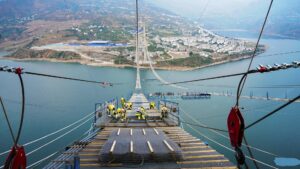
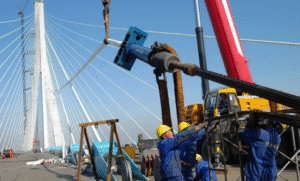
Initial Tensioning – The “Post-Tensioning” Process: As the bridge deck is constructed segment by segment, often using the balanced cantilever method, stay cables are installed and tensioned. This is a classic application of post-tensioning, where the tendons (the cables) are stressed after the concrete deck has gained sufficient strength. Heavy-duty hydraulic jacking equipment is used to pull each cable to its specified force, meticulously lifting and supporting the new deck segment.
-
Creating a State of Compression: This initial tensioning applies a powerful upward force to the deck, placing the entire concrete structure into a state of compression. This is crucial because concrete possesses tremendous compressive strength but is very weak in tension. By proactively eliminating tensile stresses, the stay cables prevent the concrete deck from developing cracks under its own weight and subsequent traffic loads. This significantly enhances the bridge’s durability and fatigue resistance.
-
Load Balancing and Continuous Adjustment: The prestressing force is calibrated to counteract not just the dead load but also the anticipated live loads (traffic, wind, etc.). In many modern bridges, the force in cables can be monitored and even adjusted years after construction to compensate for concrete creep, shrinkage, or changes in the load environment, a process often managed under a comprehensive structural health monitoring regime.
For a deeper dive into the standards and fundamentals of this practice, the Post-Tensioning Institute (PTI) provides excellent resources and design guidelines that are referenced globally.
Cable-Stayed Bridge Design: Configurations and Aesthetics
The arrangement of stay cables is not just an aesthetic choice; it fundamentally affects the structural behavior. The two primary configurations are:
-
Harp Pattern: The cables are parallel to each other, connecting at different heights on the tower but anchored at equidistant points on the deck. This creates a elegant, orderly appearance but requires taller towers.
-
Fan Pattern: All cables connect to, or radiate from, the top of the tower. This is structurally very efficient, minimizing bending moments in the tower, and is one of the most common patterns seen today.
A hybrid, the Semi-Fan Pattern, is also widely used, offering a balance of efficiency and constructability. The choice of pattern influences the flow of forces, the required quantity of prestressing steel, and the final iconic silhouette of the bridge.
Advantages That Define Modern Infrastructure
The rise of the cable-stayed bridge is no accident. Its advantages over other bridge types for medium to long spans (200 to 1100 meters) are compelling:
-
Structural Efficiency and Longer Spans: They allow for significantly longer spans than traditional girder bridges, reducing the number of piers needed in environmentally sensitive or navigable waterways. This efficiency translates to less material usage for a given span.
-
Cost-Effectiveness: For spans where cantilever bridges become too heavy and suspension bridges require massive anchorages, cable-stayed bridges often present the most economical solution. Their construction methodology can lead to faster project completion and lower overall costs.
-
Aesthetic Appeal and Landmark Status: The clean, modern lines offer architects and engineers great freedom to create iconic and beautiful structures. Bridges like the Russky Bridge in Russia or the Millau Viaduct in France have become national symbols, demonstrating how engineering and art can merge.
-
Construction Speed and Precision: The balanced cantilever method of construction, where segments are added symmetrically from the tower, allows for rapid, precise progress with minimal disruption to the area below. The repetitive nature of cable installation streamlines the construction process.
Critical Considerations: Ensuring a Century of Service
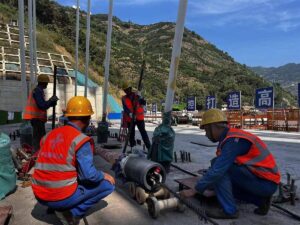
The single most important factor for the safety and longevity of a cable-stayed bridge is corrosion protection for the stay cables. Since these cables are the primary load-bearing elements and are often difficult to replace, their failure is not an option. Modern systems employ a “defense-in-depth” strategy:
-
Material Selection: The use of galvanized steel strand provides a sacrificial zinc layer as a first line of defense. In highly aggressive environments, epoxy-coated strands may be specified for an additional barrier.
-
Barrier Systems: The HDPE sheathing acts as a tough, durable outer shell. Inside, the cavity is filled with corrosion-inhibiting grease under high pressure, which completely envelops each strand, blocking moisture and oxygen.
-
Advanced Monitoring – The Bridge’s Nervous System: Structural health monitoring (SHM) is no longer a luxury but a standard practice for major bridges. Engineers use a network of sensors, including:
-
Accelerometers to monitor cable vibrations and detect any changes in dynamic properties.
-
Strain Gauges to measure tendon stress in real-time.
-
Fiber Optic Sensors embedded in cables to provide distributed data on strain and temperature along their entire length.
-
Load Cells in anchorages to directly measure the force in the cable.
-
This data is vital for planning predictive maintenance, assessing the impact of extreme events, and ensuring the long-term safety and serviceability of the structure. Organizations like the International Federation for Structural Concrete (fib) publish detailed codes, such as the fib Bulletin 30: Acceptance of stay cable systems using prestressing steels, which are considered the global benchmark for quality and safety.
The Future of Stay Cables: Innovation on the Horizon
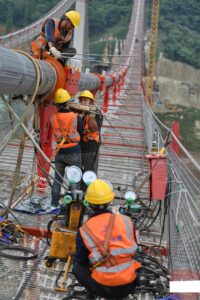
The technology of stay cables is not static. Research and development are continuously pushing the boundaries:
-
New Materials: The use of Carbon Fiber Reinforced Polymer (CFRP) cables is being actively explored. CFRP is lighter and, most importantly, immune to chloride-induced corrosion, potentially revolutionizing durability and reducing lifecycle costs.
-
Smart Cables and IoT: The integration of monitoring sensors directly into the cable during manufacturing is becoming more common. The vision of an “Internet of Bridges,” where data from thousands of sensors is analyzed by AI to predict maintenance needs, is fast becoming a reality.
-
Improved Damping Systems: To mitigate wind-induced vibrations (such as rain-wind induced vibration), advanced external and internal dampers are being developed, further enhancing the fatigue life of the cables and the comfort of users.
 Email to polarismok@ptgrouting.com or message on WhatsApp: +86-13677722014
 Ask about our latest post tensioned systems catalogue and free sample